
Understanding Tree Climbing Rope Techniques
Professional tree care involves much more than simply climbing a tree and cutting branches. Arborists rely on specialized climbing systems, knots, ropes, tools, and techniques to maintain control while working high above the ground.
At Liberty Tree & Landscape Management, our experienced tree crews continually practice and demonstrate the skills used in professional tree care. Two important areas of training include proper knot tying—such as the Figure 8 knot—and techniques for managing a pole saw and ropes while working in the canopy.
Understanding these techniques provides homeowners with a behind-the-scenes look at the knowledge, coordination, and training involved in professional tree work.

Tree Work Requires More Than the Right Equipment
Tree climbing can involve working at significant heights while navigating branches, managing ropes, operating tools, and coordinating with crew members on the ground. Without proper training and technique, even routine pruning can become challenging.
Rope management is especially important. Climbers need to understand how different knots function, how ropes should be positioned and managed, and how to prevent equipment and lines from becoming tangled or interfering with their movement.
Tool handling is equally important. When using a pole saw from an elevated position, a climber must maintain proper positioning and control while carefully managing surrounding ropes and branches.
These skills require hands-on training, repetition, communication, and experience.
Experienced Crews Trained in Professional Techniques
At Liberty Tree & Landscape Management, our experienced tree crews use established climbing and rope techniques to approach tree work with greater control and efficiency.
One technique demonstrated by our climbers is the Figure 8 knot. Recognizable by its distinctive shape, the Figure 8 is a foundational knot used in many rope and climbing applications. Understanding how to properly form, dress, and inspect knots is an important part of developing strong rope-handling skills.
Our climbers also demonstrate pole saw and roping techniques while working in the tree. This includes managing the saw and climbing system, maintaining appropriate positioning, communicating with the ground crew, and controlling ropes throughout the work area.
For larger limbs, professional rigging techniques may also be used to control how cut material is lowered rather than allowing it to fall freely. The specific equipment and technique depend on the tree, surrounding property, branch size, and work being performed.
These demonstrations highlight the technical knowledge that goes into professional tree climbing and pruning.
Leave Technical Tree Work to Trained Professionals
Homeowners can safely perform some basic tree maintenance from the ground, but climbing, overhead cutting, and technical rope work should be left to properly trained professionals.
Avoid attempting to climb trees with cutting equipment or using ropes to lower large branches without the appropriate knowledge, equipment, and experience. Tree work becomes particularly complex when trees are close to homes, vehicles, fences, utility lines, or other structures.
Instead, regularly inspect your trees from the ground. Look for dead or broken branches, limbs growing toward structures, storm damage, unusual leaning, or other changes that may indicate the tree should be evaluated.
If you notice a potential concern, a professional tree care company can determine the appropriate pruning, removal, or maintenance approach.
Rope Techniques in Action
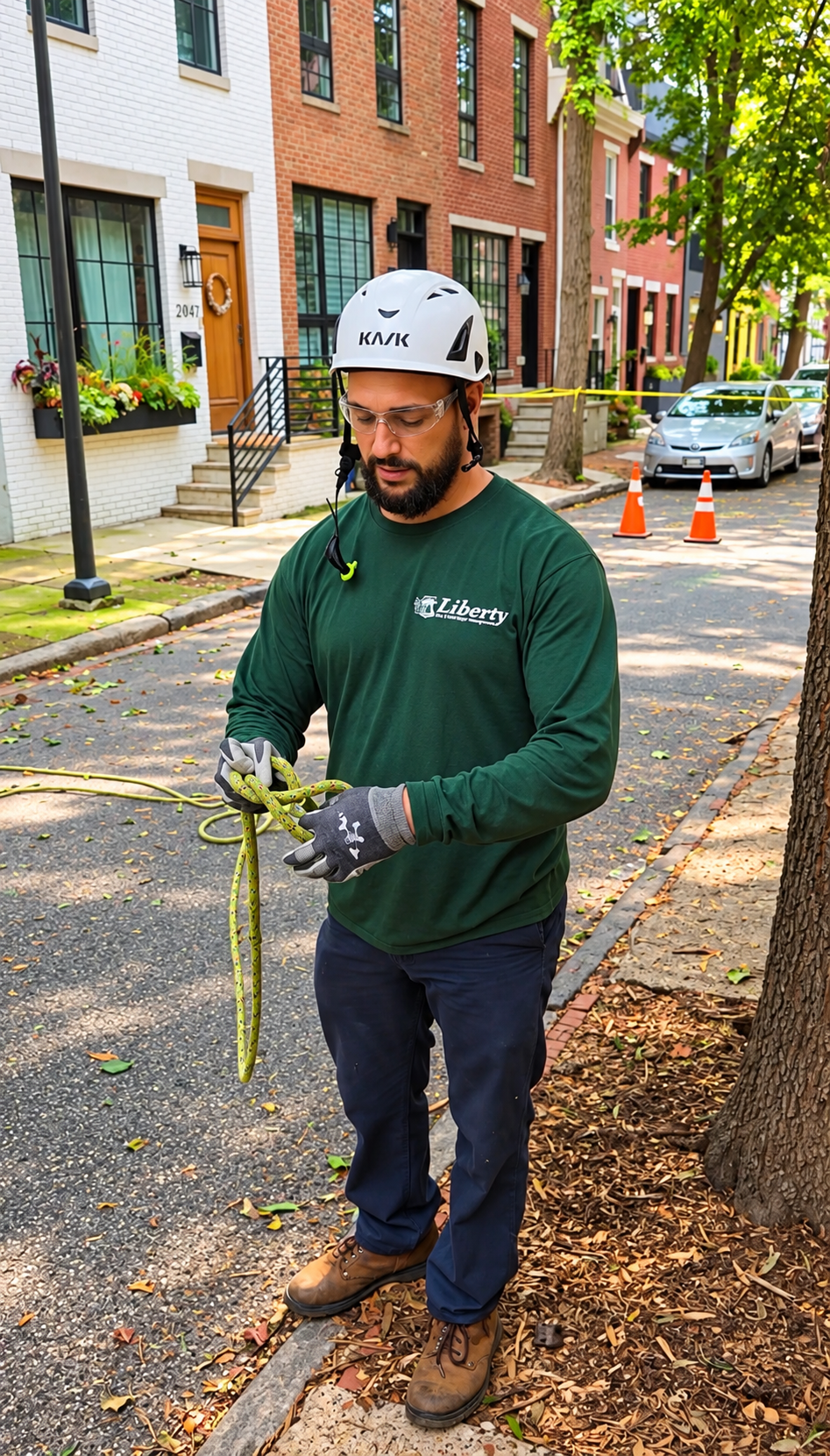
Proper rope techniques are an essential part of professional tree care. Here, one of our experienced Liberty Tree climbers demonstrates how to tie a Figure 8 knot, a foundational knot commonly used in climbing and rope work.
Continued hands-on training helps our crews strengthen their skills, reinforce proper techniques, and stay prepared for the challenges they encounter in the field.
Proper rope management is an important part of professional tree work. Here, one of our experienced Liberty Tree crew members demonstrates a slip knot and pole saw technique used in the field.

Professional tree care is all about control, precision, and teamwork. Here, our Liberty Tree crew uses specialized rope techniques to carefully lower a cut limb to the ground.
Controlled lowering helps our crew manage branches in tight spaces and work around homes, landscaping, and other surrounding property.
Figure 8 Knot Demonstration
Watch as one of our experienced Liberty Tree climbers demonstrates how to properly tie a Figure 8 knot, a foundational knot used in climbing and rope work. Proper knot tying and rope management are essential skills that help professional arborists work safely and efficiently while performing tree care.
Training Supports Better Tree Care
Proper tree climbing rope techniques are about more than knowing how to tie a knot. They are part of a larger skill set that includes equipment knowledge, communication, positioning, planning, and understanding how trees and branches respond during pruning.
Continued training helps experienced crews reinforce good habits while giving newer tree care professionals an opportunity to develop their skills under knowledgeable supervision.
At Liberty Tree & Landscape Management, we believe that investing in education and hands-on training helps our crews approach each property with the knowledge and preparation professional tree care demands.
Need professional tree pruning or have concerns about a tree on your property? Call Liberty Tree & Landscape Management at 215-886-6111 to schedule an evaluation.